If you’re a veteran dealing with chronic acid reflux or heartburn tied to your military service, you may qualify for a GERD VA rating.
Gastroesophageal reflux disease (GERD) is a long-term digestive condition where stomach acid or bile irritates the esophagus, causing symptoms like heartburn, regurgitation, chest pain, and difficulty swallowing. For many veterans, GERD can be linked to service-related factors such as certain medications, PTSD, or service-connected injuries.
In this guide, we’ll explain how the VA rates GERD, how to prove service connection, and steps you can take to strengthen your claim.
Table of Contents
- Key Takeaways
- What Causes GERD in Veterans?
- How the VA Rates GERD
- Establishing Service Connection for GERD
- Filing a VA Claim for GERD
- TDIU and GERD
- How to Build a Strong VA Claim for GERD
- Nexus Letter for GERD
- Can GERD be a Secondary Condition?
- Secondary Conditions to GERD
- Conclusion
- Medical Evidence Wins VA Claims
- FAQs | Frequently Asked Questions
Key Takeaways
- Common causes of GERD include certain medications, PTSD and stress, diet and lifestyle factors, injuries or surgeries, and sleep disorders like sleep apnea.
- The VA rates GERD at 0%, 10%, 30%, 50%, and 80% under diagnostic code 7206.
- You can receive a secondary VA rating for GERD if a service-connected condition, like PTSD or chronic pain medications, causes or aggravates it.
- A strong nexus letter can significantly increase your chances of obtaining a higher GERD VA rating.
What Causes GERD in Veterans?

GERD can significantly impact your quality of life, and for many veterans, it’s a condition that can be traced back to their military service.
A 2021 study found that GERD is the most prevalent gastrointestinal condition among veterans, with over 3.4 million diagnosed cases in the Veterans Health Administration (VHA) outpatient setting since 2000.
Common causes of GERD in veterans include:
- Medications: Certain medications prescribed for service-connected conditions, such as NSAIDs for pain or antidepressants for PTSD, can irritate the esophagus and increase acid reflux.
- Post-Traumatic Stress Disorder (PTSD) and Stress: Chronic stress and PTSD can lead to gastrointestinal issues, including GERD.
- Diet and Lifestyle: Military service may contribute to poor diet, smoking, or alcohol use, which are risk factors for GERD.
- Injuries or Surgeries: Abdominal or esophageal injuries sustained during service may increase the risk of developing GERD.
- Sleep Disorders: Sleep apnea and other sleep disturbances are common among veterans and can exacerbate GERD symptoms.
How the VA Rates GERD
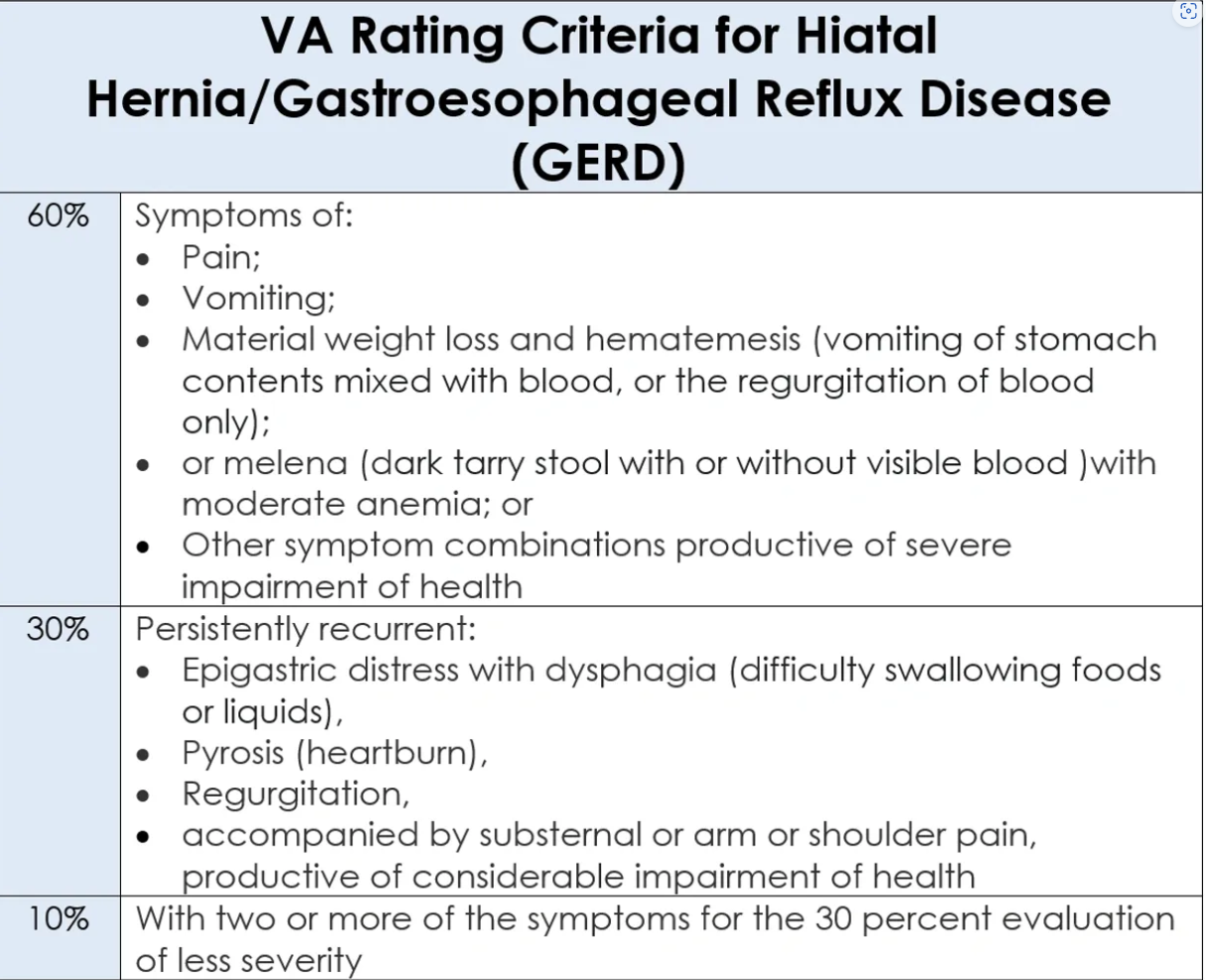
The VA assigns GERD ratings under diagnostic code 7206 at 0%, 10%, 30%, 50%, and 80%.
GERD VA ratings are assigned as follows:
80% VA Rating
Documented history of recurrent or refractory esophageal stricture(s) causing dysphagia with at least one of the symptoms present: (1) aspiration, (2) undernutrition, and/or (3) substantial weight loss as defined by § 4.112(a) and treatment with either surgical correction of esophageal stricture(s) or percutaneous esophago-gastrointestinal tube (PEG tube)
50% VA Rating
Documented history of recurrent or refractory esophageal stricture(s) causing dysphagia which requires at least one of the following: (1) dilatation 3 or more times per year, (2) dilatation using steroids at least one time per year, or (3) esophageal stent placement
30% VA Rating
Documented history of recurrent esophageal stricture(s) causing dysphagia which requires dilatation no more than 2 times per year
10% VA Rating
Documented history of esophageal stricture(s) that requires daily medications to control dysphagia otherwise asymptomatic
0% VA Rating
Documented history without daily symptoms or requirement for daily medications
Related Post: GERD VA Disability Rating Changes
Establishing Service Connection for GERD
To receive a GERD VA rating, you must show that your military service caused or worsened your condition.
This requires establishing a connection between your GERD and your service, whether directly or as a secondary condition linked to another service-connected disability.
You can prove service connection for GERD with these three key elements:
- A current medical diagnosis of GERD
- An in-service event, injury, or illness that caused or aggravated your condition
- A medical nexus, or link, connecting your military service to your condition (can be a nexus letter)
Filing a VA Claim for GERD
To qualify for a GERD VA disability rating, you must file a VA claim using VA Form 21-526EZ.
You can file a VA claim:
- By mail
- Via fax
- In person at a VA regional office
If you plan to file for disability compensation using paper form, consider submitting an intent to file form first.
This allows you to gather evidence while protecting your effective date, which could mean retroactive payments.
Did you know? If you’re filing online, you don’t need to submit an intent to file because the effective date is automatically set when you begin completing the form.
TDIU and GERD
If your GERD symptoms are severe enough to prevent you from maintaining substantially gainful employment, you may qualify for Total Disability Based on Individual Unemployability (TDIU).
TDIU provides compensation at the 100% disability rate, even if your GERD rating alone doesn’t reach 100%.
To qualify for TDIU, you must have a single service-connected disability rated at 60% or more, or two or more service-connected disabilities with one rated at least 40% and a combined rating of 70% or higher.
Calculate Your Combined VA Rating
How to Build a Strong VA Claim for GERD
Although there are no guarantees when filing a VA claim, taking specific steps may boost your chances of approval, including:
- Obtaining a Nexus Letter with high probative value
- Documenting your symptoms thoroughly
- Providing lay statements
- Obtaining a GERD DBQ (Disability Benefits Questionnaire)
- Including a detailed personal statement
Nexus Letter for GERD
A nexus letter is a medical document connecting your current diagnosis to a specific event, injury, or exposure during your military service.
For GERD, a nexus letter can be crucial in establishing service connection, especially if your initial claim was denied or your condition is secondary to another service-connected disability.
While the VA doesn’t require a nexus letter, it can significantly strengthen your case by providing solid medical evidence and a clear link to your service.
The experienced professionals at Telemedica can provide a well-crafted nexus letter for GERD.
Can GERD be a Secondary Condition?
Yes, many conditions and medications could be responsible for causing or aggravating GERD.
GERD Secondary to Medications
In some cases, asthma medications such as Elixophyllin, Theo-24, NSAIDs, and Theochron can exacerbate acid reflux.
Drugs taken to treat anxiety and depression can also contribute to GERD by causing mucosal damage, reducing lower esophageal sphincter pressure (LESP), or affecting esophagogastric motility.
NOTE: Don’t stop taking any medications prescribed to you without first talking with your doctor.
GERD Secondary to Asthma
According to a study published in The Gastroenterology and Hepatology Journal, acid reflux is connected to asthma. It’s difficult to say why, but acid reflux can make asthma worse and vice versa.
GERD Secondary to Anxiety
GERD can develop when mental health conditions, such as anxiety and panic disorder, lead to an overproduction of stomach acid.
GERD Secondary to PTSD
Like anxiety, GERD can develop when symptoms of Post-traumatic Stress Disorder (PTSD), such as stress and depression, lead to an overproduction of stomach acid.
Medications taken to treat PTSD can also lead to GERD as a side effect.
GERD Secondary to Migraines
If migraines are causing your GERD, it’s likely because of the medication you’re taking to treat them.
In fact, a study published in The Journal of Headache and Pain recommends that physicians “minimize prescribing NSAIDs or NSAID-containing acute migraine medications in this population” (referring to patients who also have GERD).
Secondary Conditions to GERD
It’s also possible to increase your combined VA rating for GERD if you believe your GERD is responsible for a secondary condition.
A secondary condition is a medical condition that is caused or made worse by a disability that’s already rated by the VA. For example:
>> View our full guide to VA Secondary Conditions to GERD
Expert Tip: If you are filing a VA claim for secondary service connection OR a claim that was previously denied service connection—a credible Nexus Letter may be the missing link. (see related: When Do You Need a Nexus Letter?)
Conclusion
The VA rates GERD from 0% to 80% under diagnostic code 7206, depending on the severity and impact of your symptoms. Whether your GERD began during service or developed secondary to another service-connected condition, the key to winning your claim is solid medical evidence—especially a clear nexus linking your condition to service.
If your GERD symptoms are affecting your quality of life or ability to work, don’t wait to file your claim. Gather your medical records, consider a detailed nexus letter, and present a strong case for the rating you deserve.
Medical Evidence Wins VA Claims
Did you know that a lack of medical evidence is a top reason VA disability claims are denied?
Medical evidence is a crucial piece of the puzzle that VA raters consider when reviewing a disability claim. Telemedica provides solutions for veterans looking to bolster their claims through high-quality medical evidence that wins claims!
Schedule your 20-minute consultation, get answers for your service-connected disability, and start on your path to well-being.
FAQs | Frequently Asked Questions
What is the VA rating for GERD?
The VA rates GERD under the diagnostic code 7206 for digestive disorders, ranging from 0% to 80% depending on the severity and frequency of symptoms.
Is GERD a presumptive condition?
No, GERD is not considered a presumptive condition. You must provide evidence linking your GERD to your military service or a service-connected disability.
Do I need a nexus letter for a VA GERD rating?
While nexus letters aren’t required, they may significantly strengthen your claim by clearly connecting your GERD to your service or a secondary condition.
How do I prove service connection for GERD?
You can prove service connection by providing medical records, a strong nexus letter, lay statements, and a GERD DBQ outlining how your condition relates to your military service.
Can I receive a secondary VA rating for GERD?
Yes, GERD may qualify as a secondary condition if it’s caused or worsened by a service-connected disability, such as PTSD or certain medications.
Content Reviewed by: Tara Thompson, PA-C
Tara Thompson PA-C is a board-certified Physician Assistant. She completed her training through Chatham University, graduating with a Master’s of Physician Assistant Studies Degree in 2007. Her work experience has been diverse and includes first assist in all surgical specialties, Plastic Surgery and ENT clinical work, and Emergency Medicine. She served as a Physician Assistant in the US Army from 2009-2021 and has been an expert in medical evidence for VA disability claims since 2019.